
The queue to talk to a robot ran longer than the queue for coffee at Melbourne Connect on Friday, as the AI & Robotics Innovation Expo closed out Melbourne Innovation Week 2026, welcoming over 400 attendees throughout the day.
The robot in question was Lumi, a talking, moving and dancing humanoid built by local startup Roboly, and it was the clear draw of the day. From 11am to 3pm, The Launchpad and The Lab filled with founders, researchers, students and politicians, all circling the same floor of demos and stage pitches.
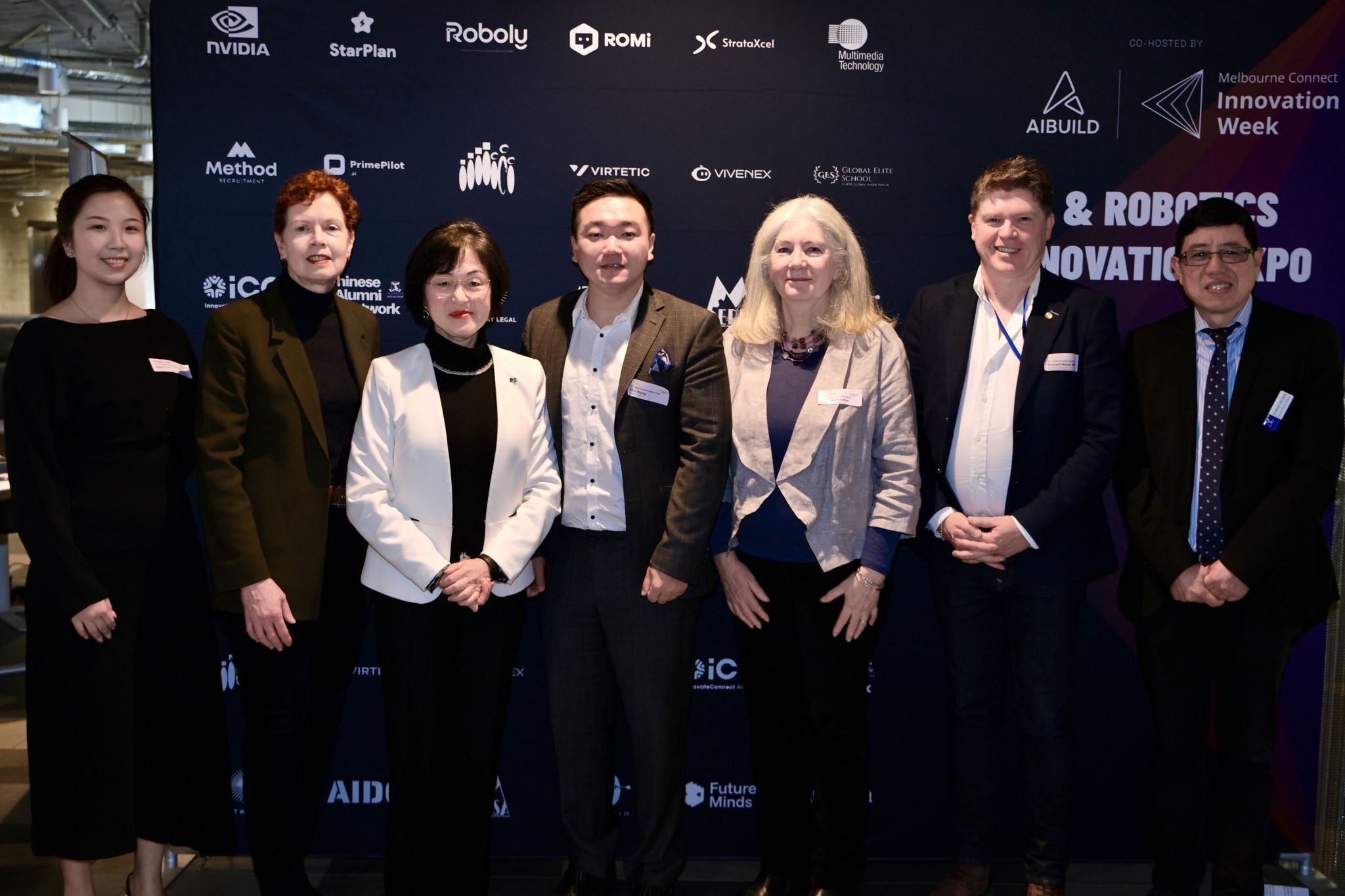
The floor drew a notably heavyweight guest list, among them Victoria’s Lead Scientist Dr Amanda Caples, City of Melbourne Councillor Gladys Liu, and Victoria’s Agent General to the UK and Commissioner to Europe and Israel, Tim Dillon.
A few stands over from Lumi, different AI and robotic innovations were showcasing their capabilities, including Aurora, a contactless smart sleep monitor, and Vivenex AI, which had two units of its companion robot Emi on display.
Built by psychiatrists, Emi is designed for elderly Australians ageing at home or in isolation, with fall and accident detection and a video-call function so family can check in through the robot’s screen.
The expo was hosted by AI venture builder AIBUILD, and Daisy Liu, founder and CEO of AI hiring platform StarPlan, with NVIDIA as principal sponsor.
NVIDIA’s Dr Johan Barthelemy, Senior AI Scientist, walked the room through the blueprint for building robotics through applied AI, breaking down the underlying stack that connects a talking humanoid to a companion robot, a warehouse robot, and everything in between.
He was joined on the day by NVIDIA’s Dr Susan Zhang, Head of Startup & VC Partnerships.
Yifei Wang, CEO of AIBUILD and host for the AI & Robotics Innovation Expo, said: “AIBUILD was incredibly proud to host this event; it brought together innovators of all shapes and sizes in Melbourne’s tech ecosystem, and each delivered their own unique solution to existing real-world problems.”
“What stood out to us most wasn’t any single piece of technology, but the sheer diversity of it. We had a robot people were queuing up to talk to and watch dance (literally dancing to Gangnam Style to the crowd), right next to a companion robot built for someone’s home. Then across the room we had recruitment and HR AI startups Method Recruitment and StarPlan, property management AI ventures such as StrataXcel and AskROMi, and even mind-controlled drones.”
“It was such a positive representation of Melbourne’s AI sector right now; not just one narrow lane, but future-forward founders solving very different problems with the same underlying momentum and passion behind them,” said Wang.
Between demos, Shadow Minister for AI Richard Welch MP took the stage for a special address, pressing the case that Victoria’s policy settings need to keep pace with what the sector is already doing on its own. His presence, alongside Dr Caples, Cr Liu and Victorian Government Senior Investment Manager Nick Yan underscored the Victorian Government’s growing engagement with the sector.
Following this, University of Melbourne’s Professor Lihai Zhang covered the financial pathways to building an AI business, from raising capital to navigating the startup ecosystem, while Professor Jenny Waycott took the room into the sociological case for introducing companion robots into homes to combat isolation and loneliness.
Alongside these talks was a run of stage pitches from StarPlan, StrataXcel, property and renter chatbot AskROMi, and HR and hiring platform Method Recruitment.
Co-host, event organiser, and CEO of StarPlan Daisy Liu said: “We had a great turnout for this event, and the level of innovation, intelligence and diversity on display made for a genuinely promising day showcasing Melbourne’s technology startup sector.”
“From AI and robotics startups to scale-ups, the expo was the perfect way to close out Melbourne’s Innovation Week, and I, along with the team at AIBUILD, was honoured to bring it to life, giving emerging innovators the chance to show what their solutions could mean for the real future of technology adoption in Victoria and Australia,” added Liu.