


Infor has introduced its new Infor Industry AI architecture and the next evolution of Infor Velocity Suite, as new research reveals Australian businesses are achieving above-average efficiency improvements from AI while requiring less manual review than other Asia Pacific and Japan (APJ) markets surveyed.
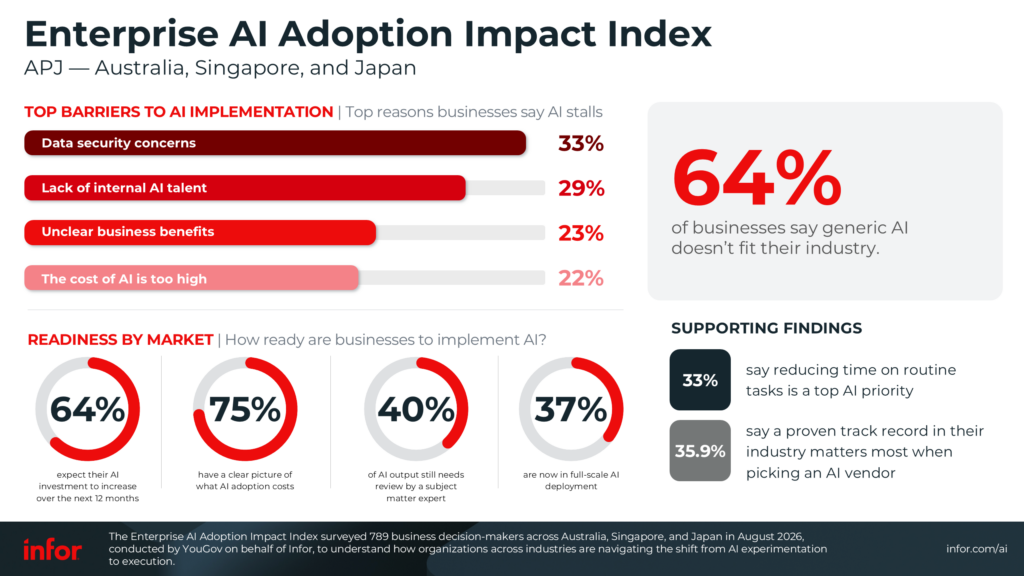
The announcement comes alongside the second edition of the Infor Enterprise AI Adoption Impact Index, which surveyed more than 2,000 business decision-makers across seven markets, including 789 across Australia, Japan and Singapore.
The research found that Australian enterprises reported average efficiency gains of 34% from AI, above the global average of 33%. Just 44% of AI output required manual expert review, the lowest of the APJ markets surveyed and compared with 60% in Singapore.
Australia is also progressing with AI adoption, with 42% of enterprises having reached full-scale deployment and 85% reporting they can manage AI implementation internally without disrupting daily operations.
However, challenges remain. Seven in 10 Australian businesses said generic AI solutions do not adequately meet the specific needs of their industry, highlighting the difficulties organisations face when applying AI to specialised workflows, regulatory requirements and industry data.
“Australia has reached the point where simply deploying more AI is no longer enough. The competitive advantage will come from applying AI to the processes that matter most, with the industry context to make the right decisions and the governance to give agents greater responsibility with confidence,” said Aidan Brecknell, Vice President and Managing Director, Pacific Region, Infor. “Australia already has strong foundations; the priority now is to protect that advantage by turning AI investment into faster, more precise and accountable outcomes.”
Infor introduces new industry-specific AI architecture
Infor Industry AI is designed to help businesses move from AI experimentation to practical deployment by embedding industry-specific intelligence, connected AI agents and governance capabilities into enterprise workflows.
The architecture supports what Infor describes as the agentic enterprise, where employees and AI agents work together across business processes rather than operating through disconnected applications.
Alongside the new architecture, Infor has announced the next evolution of Infor Velocity Suite, including personalised adaptive user experiences, expanded governance capabilities and additional Industry AI agents.
Unlike generic AI tools, Infor’s Industry AI agents draw on industry-specific processes, terminology and business data to support decision-making and automate operational tasks. The approach is intended to reduce manual intervention and help organisations achieve value from AI investment more quickly.
“At Infor, we don’t think our job ends when we hand a customer an AI tool, it starts there,” said Kevin Samuelson, CEO, Infor. “Our research shows what customers have been telling us directly: generic AI doesn’t understand what a factory floor, distributor or food and beverage manufacturer needs. When every company has access to the same powerful AI models, what sets leaders apart is what those models know about the business. Decades of knowledge is built into every layer of Infor’s architecture, which is why our agents deliver precise, trusted results from day one. We meet people in the AI tools they already use and bring the industry context those tools are missing.”
Four capabilities underpin Infor Industry AI
The new architecture is built around four platform pillars designed to support the deployment and management of AI across enterprise operations.
- Precise Outcomes: An expanded suite of Industry AI agents uses industry-specific logic drawn from Infor Industry CloudSuites, Industry Process Catalogs and domain language models. Infor reports that customers using these capabilities have processed shipments up to 60% faster. Its GenAI Knowledge Hub is also now generally available, enabling customers to build custom AI agents.
- Open & Connected: The architecture connects Infor and non-Infor applications, allowing AI agents to operate across existing enterprise systems. Through Infor IQ, agents can access a consistent understanding of business processes and data, supported by a catalogue of more than 350 preconfigured use cases.
- Easy to Use: Infor’s Adaptive UX brings relevant information and actions into personalised, role-based interfaces, reducing the need to navigate multiple applications. Users can interact through Infor’s GenAI Assistant or other AI assistants already in use. Infor reports that customers have achieved time savings of up to 90% across procurement, supply chain, manufacturing and sales workflows.
- Governed: Enhanced governance, risk and compliance capabilities provide human approval workflows, agent permissions and audit trails. These controls are embedded in the platform’s orchestration layer to support accountability and traceability. Infor reports that customers have achieved reductions of up to 90% in auditing costs associated with access management.
The architecture is also intended to support organisations looking to automate complex operational processes while retaining visibility and control over AI-driven decisions.
“AI only matters when it creates real value,” said Alicia Thompson, CTO, Team Air Distributing. “Infor has kept pace with our ambitions, pairing Infor Industry AI Agents with Forward Deployed Engineers who understand our industry and work as an extension of our team. Together, we’re reducing manual work and turning operational challenges into practical improvements, building trust one process at a time.”
Australian businesses focus on AI governance and value
Beyond efficiency improvements, Infor’s research found Australian organisations are increasingly focused on the cost, governance and practical application of AI.
Australia recorded the highest level of AI cost clarity across the seven markets surveyed, with 91% of businesses saying they understood the costs associated with AI adoption. A further 68% planned to increase their AI investment over the next year.
Governance was another area where Australian businesses performed comparatively well. Just 6% reported having no designated owner for AI governance, risk or compliance, compared with 10% globally and 21% in Japan.
However, as AI takes on greater responsibility for business processes, the research points to the need for stronger accountability and oversight.
Globally, more than half of business leaders said they were comfortable allowing autonomous AI agents to execute critical business processes without human input at every step. Just 11% preferred humans to make high-stakes decisions without any AI involvement.
Despite growing adoption, only 10% of enterprises globally had appointed a Chief AI Officer, suggesting dedicated executive accountability for AI remains relatively uncommon.
The findings also highlight challenges for industries with complex operational requirements.
Across all seven markets, 73% of manufacturing respondents said off-the-shelf AI did not meet their needs, rising to 76% among distribution businesses and 67% in retail.
These results suggest that as businesses move towards more advanced AI applications, industry-specific knowledge, integration with existing systems and appropriate governance will become increasingly important.
“The next phase of enterprise AI will be defined not by access to models, but by how effectively organizations apply AI within the context of their industry and business processes,” said Shashi Bellamkonda, Principal Research Director at Info-Tech Research Group. “Infor’s focus on industry-specific intelligence, interoperability, and embedded governance addresses several of the practical barriers organizations face as they move from AI experimentation to trusted, measurable outcomes.”
